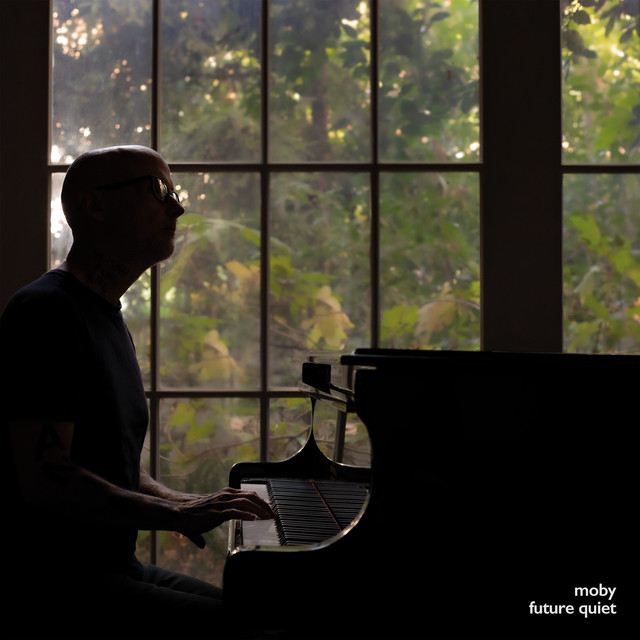
NRN Radio is Moby’s Future Quiet (2026)

 DJ Don Edwards
Moby’s Future Quiet (2026): A Monumental Ambient Statement from an Electronic Pioneer Entering His Most Reflective Era
On February 20, 2026, Moby released his 23rd studio album, Future Quiet—a project that decisively shifts the narrative around his legacy and deepens his standing as one of modern music’s most restless and reflective innovators.
For casual listeners, Moby may forever be associated with era-defining electronic anthems and dancefloor crossovers. But Future Quiet signals something else entirely. It is restrained. Introspective. Expansive without being loud. Emotional without being dramatic.
This is not a return to the rave.
This is a retreat inward.
And in 2026’s hyper-saturated digital culture, that inward turn feels radical.
From Dancefloor Architect to Ambient Minimalist
Across three decades, Moby has consistently evolved—sometimes ahead of the curve, sometimes defiantly against it. With Future Quiet, he continues a trajectory that has been quietly building in recent years: a movement toward ambient soundscapes, piano minimalism, and orchestral composition.
Where earlier albums pulsed with kinetic urgency, Future Quiet breathes.
The record unfolds with:
- Sparse piano motifs
- Slow-building orchestral arrangements
- Subtle electronic textures
- Atmospheric layering that prioritizes space over momentum
This is music built for reflection rather than release.
It does not chase a hook.
It invites immersion.
Reimagining the Past: “When It’s Cold I’d Like to Die” (2026)
At the emotional center of Future Quiet is a reimagined version of “When It’s Cold I’d Like to Die,” originally released in 1995. Rather than recreating nostalgia, Moby reconstructs the song with contemporary weight.
Featuring Jacob Lusk, the new version feels less like a revival and more like a reckoning.
The arrangement is restrained—allowing Lusk’s voice to carry vulnerability across a backdrop of subtle orchestration and delicate piano. The track becomes a bridge between eras: youthful existential melancholy transformed into seasoned contemplation.
This is not sentimentality.
It is reinterpretation through experience.
Collaboration as Emotional Architecture
Though the album leans heavily into minimalism, it is not solitary. Future Quiet features collaborations that enhance its emotional depth without disrupting its meditative flow.
Guest contributors include:
- India Carney
- serpentwithfeet
- Elise Serenelle
Each artist adds tonal nuance and vocal intimacy, expanding the album’s emotional palette while respecting its quiet core.
The production never overwhelms the performances. Instead, it frames them—like light filtering through curtains at dusk.
The Sonic Identity of Future Quiet
From a technical standpoint, Future Quiet represents a deliberate departure from the rhythmic propulsion that once defined Moby’s mainstream crossover years.
Key characteristics include:
- Reduced BPM structures or complete absence of percussive drive
- Organic instrumentation blended with ambient electronic atmospheres
- Orchestral flourishes that feel cinematic without bombast
- Extended tonal decays that allow silence to become compositional
The pacing is deliberate. Tracks unfold patiently, allowing harmonic progressions to settle before evolving.
This approach reflects a composer comfortable with restraint—a musician who understands that intensity does not require volume.
Context in a 23-Album Career
Reaching a 23rd studio album is not just a statistical milestone—it is a testament to creative endurance.
Few artists from the early 1990s electronic movement have sustained relevance across decades of shifting formats, platforms, and trends. Fewer still have reinvented themselves as frequently.
Future Quiet stands as one of Moby’s most cohesive late-career statements.
It does not attempt to replicate his commercial apex.
It does not chase algorithmic virality.
It does not attempt to reclaim club dominance.
Instead, it refines his identity as a composer of atmosphere.
Why Future Quiet Matters in 2026
In a cultural moment defined by constant stimulation—short-form content, compressed attention spans, algorithmic churn—Future Quiet feels almost confrontational in its stillness.
It asks the listener to slow down.
To sit.
To listen.
The album aligns with a broader 2026 trend toward ambient and neoclassical crossovers, but Moby’s contribution carries historical weight. When a pioneer of electronic maximalism embraces minimalism so fully, it reframes the genre’s future trajectory.
Silence becomes a statement.
Space becomes structure.
Stillness becomes movement.
The NRN Radio Show Connection
For listeners of the NRN Radio Show, Future Quiet represents exactly the kind of thoughtful, genre-expanding work that thrives in curated environments.
This is music that rewards uninterrupted listening. It pairs seamlessly with late-night broadcasts, reflective programming blocks, and deep-dive album features.
It is headphone music.
Meditative music.
Transitional music for an era recalibrating its emotional center.
A Career Rewritten in Real Time
Moby’s influence on electronic music is well documented. But Future Quiet shifts the conversation from influence to intention.
This album is not about proving relevance.
It is about pursuing truth.
It is darker in tone, yes—but also clearer in purpose. The orchestral arrangements never swell into melodrama. The ambient textures never drift into aimlessness. The piano motifs remain understated but resolute.
After 30+ years in the public eye, Moby has arrived at a place where subtraction becomes his boldest creative move.
The Verdict
Future Quiet is not designed for the dancefloor.
It is designed for contemplation.
It is not nostalgia.
It is evolution.
In 2026, when so much music competes for attention, Moby has chosen to command it by lowering the volume.
For JamFest readers seeking depth, intention, and mature electronic artistry, this is one of the year’s essential releases.
And for those who have followed Moby from warehouse anthems to orchestral introspection, Future Quiet confirms what his career has always suggested:
The most powerful sound is often the one that lingers long after the music fades.