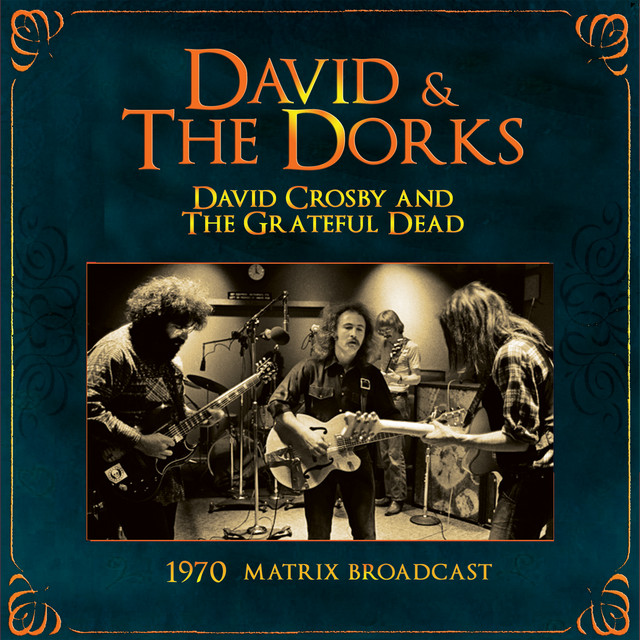
David & The Dorks Live at The Matrix in San Francisco on December 15, 1970

 DJ Don Edwards
JamFest Unlocks a Lost Chapter of Live Music History: David Crosby, The Grateful Dead, and the Matrix Recordings Reimagined Through Live Nuggets – The Band: The core lineup featured David Crosby (guitar/vocals) alongside Grateful Dead members Jerry Garcia (guitar), Phil Lesh (bass), and Mickey Hart (drums). Some historians and listeners suggest Bill Kreutzmann may have actually been the drummer for the December 15th show.
There are rare moments in music history when collaboration transcends planning, when artists step outside of structure and into something far more instinctive—raw, unfiltered, and entirely alive. JamFest has built its identity around capturing and presenting those moments, and nowhere is that mission more fully realized than in Live Nuggets, the network’s Tuesday night flagship. Airing every week at 9PM EST, Live Nuggets is not simply a program—it is a full-length, uninterrupted concert experience, meticulously curated to deliver performances in their original, unedited form. It is where the archive breathes, where the mythology of live music becomes tangible, and where listeners are invited into rooms they were never meant to access.
One of the most compelling entries in this ongoing series is the remarkable collaboration known as David Crosby & The Grateful Dead (1970) Matrix, a set of recordings that capture a fleeting yet deeply influential convergence of artists at a critical moment in their creative evolution. These sessions, often performed under the tongue-in-cheek name David & The Dorks—and occasionally billed as “Jerry Garcia and Friends”—were never designed for mass consumption. They were informal, unannounced, and driven by experimentation rather than expectation. And that is precisely what makes them essential.
The setting was The Matrix, a small but culturally significant San Francisco club founded by members of Jefferson Airplane. Unlike the large ballrooms and theaters that would later define the era, The Matrix offered intimacy, immediacy, and a direct connection between performer and audience. It was the kind of room where ideas could be tested in real time, where songs could evolve in front of listeners, and where the boundaries between rehearsal and performance simply did not exist.
David Crosby arrived in the Bay Area during a period of intense creativity, working on what would become his landmark solo album, If I Could Only Remember My Name. Rather than retreating into the isolation of the studio, he leaned into collaboration, surrounding himself with a rotating cast of musicians who shared both his curiosity and his willingness to explore. Among them were key members of the Grateful Dead—Jerry Garcia, Phil Lesh, and Mickey Hart—artists whose entire ethos was built on improvisation, risk, and the pursuit of musical conversation over perfection.
The most widely circulated recording from this collaboration dates to December 15, 1970, a performance that was captured on soundboard and broadcast live over KSAN-FM. Even within the Grateful Dead’s vast live catalog, this recording stands apart. It is not a polished concert in the traditional sense. It is something more elusive—a snapshot of musicians in the process of discovery, playing without a net and without the expectations that typically accompany a billed performance.
The lineup itself reads like a blueprint for improvisational synergy. Crosby’s voice and rhythm guitar provide the foundation, while Garcia’s lead work moves fluidly between melodic precision and exploratory phrasing. Phil Lesh’s bass is not confined to traditional roles; it operates as a counterpoint, weaving in and out of the harmonic structure. The drumming—most often attributed to Mickey Hart, though some accounts suggest Bill Kreutzmann may have been present—anchors the performance while still allowing space for the music to expand and contract organically.
What unfolds across the set is a seamless blend of original material, reinterpretations, and traditional forms. Crosby’s compositions, including “Cowboy Movie,” “Laughing,” “Triad,” and “The Wall Song,” are presented in early, evolving versions that reveal the architecture behind the finished recordings. These are not static renditions; they are living frameworks, shaped in real time by the interplay between musicians who are listening as intently as they are playing.
Interwoven with these originals are selections that draw from the Grateful Dead’s repertoire and the broader American songbook. “Bertha” appears with a looseness that underscores its rhythmic core, while traditional pieces like “Deep Elem Blues,” “Motherless Children,” and “Drop Down Mama” connect the performance to the roots of American folk and blues. These songs serve as both anchors and launching points, providing familiar structures that the band can stretch, reshape, and reinterpret.
Perhaps most revealing are the rehearsal fragments and rarities associated with these sessions. Early explorations of “Bird Song,” a track that would later become a cornerstone of the Grateful Dead’s live identity, offer insight into the band’s compositional process. Interpretations of “Eight Miles High” and “Alabama Bound” further illustrate the fluidity of the collaboration, blurring the lines between genres and influences in a way that feels both natural and inevitable.
These performances are also deeply connected to the broader creative collective known as the Planet Earth Rock and Roll Orchestra, or PERRO—a loose network of Bay Area musicians that included members of the Grateful Dead, Jefferson Airplane, and Quicksilver Messenger Service. Operating primarily out of Wally Heider Studios, this collective embodied a philosophy of open collaboration, where the focus was not on ownership or authorship, but on exploration and shared creativity. The Matrix recordings can be understood as a live extension of that ethos, bringing the spontaneity of the studio into a public, albeit intimate, setting.
For decades, these recordings circulated in the shadows—passed between collectors, traded among enthusiasts, and discussed in the kind of reverent tones reserved for truly rare material. Today, they have found a broader audience, appearing in various formats and archival platforms. Yet even as accessibility has increased, the essence of the recordings remains unchanged. They still feel like a discovery, like something uncovered rather than presented.
Through Live Nuggets, JamFest is giving these performances the platform they deserve—not as curiosities, but as central chapters in the story of live music. By airing the concert in its entirety, without interruption or dilution, the program preserves the integrity of the original experience. Listeners are not given excerpts or highlights; they are given the room, the night, and the full arc of the performance as it unfolded.
This approach is what sets JamFest apart. It is not interested in reducing music to moments; it is committed to presenting the whole. Live Nuggets embodies that philosophy, offering a weekly destination where listeners can engage deeply, where context matters, and where the line between past and present dissolves.
For audiences, the value is profound. These broadcasts provide access to performances that are not just historically significant, but artistically vital. They offer a window into the creative process, revealing how songs are built, how ideas are tested, and how collaboration can lead to something greater than the sum of its parts.
As JamFest continues to expand its reach and refine its programming, Live Nuggets stands as a cornerstone of its identity—a clear statement that live music, in its purest form, still holds unmatched power. And with the inclusion of recordings like David Crosby & The Grateful Dead (1970) Matrix, that power is being delivered with clarity, depth, and a level of respect that ensures these moments will continue to resonate for generations to come.
- Crosby Material: “Cowboy Movie,” “Laughing,” “Triad,” and “The Wall Song” (later a Crosby & Nash staple).
- Dead/Traditional: “Bertha,” “Deep Elem Blues,” “Motherless Children,” and “Drop Down Mama”.
- Rehearsal Rarities: Studio rehearsal tapes also exist, capturing the band working through early versions of “Bird Song,” “Eight Miles High,” and “Alabama Bound”