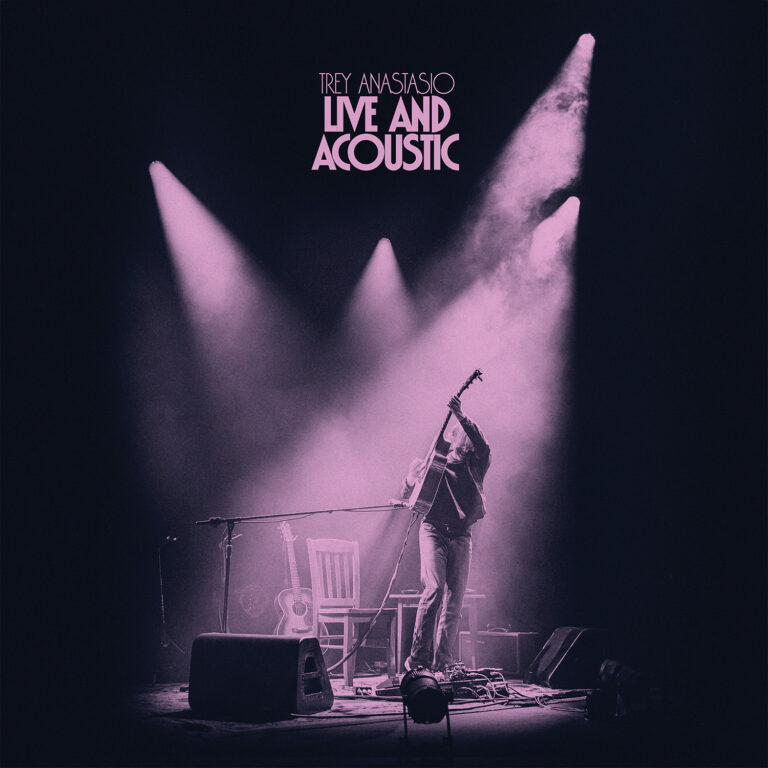
Trey Anastasio Live and Acoustic on the NRN Radio Show!

 DJ Don Edwards
Trey Anastasio Reframes a Legendary Catalog with Live and Acoustic as the 2026 Tour Signals a Defining Moment for the Modern Jam Landscape and NRN Radio Show Rotation
In a musical ecosystem where scale, improvisation, and extended exploration have long defined the upper tier of the jam world, Trey Anastasio has chosen a different path with Live and Acoustic, a release that strips away the architecture of expansion and replaces it with discipline, structure, and clarity. Issued on Rubber Jungle Records following his sold-out 2025 Spring Acoustic Tour, the album represents a deliberate recalibration—one that does not diminish the magnitude of his catalog, but instead reveals its underlying design with a level of focus rarely encountered in his live output.
Within the JamFest editorial lens, where the intersection of live performance and recorded material is treated as a continuous conversation, Live and Acoustic emerges as a pivotal document. It is already gaining traction as a featured cornerstone within the NRN Radio Show, where its refined arrangements and compositional transparency offer a compelling counterbalance to the improvisational sprawl that typically defines the format. This is not a side project or a conceptual detour. It is a direct statement about the durability and adaptability of one of the most expansive songbooks in American music.
For decades, Anastasio’s work—both within Phish and across his solo output—has been defined by elasticity. Songs function as frameworks, launching points for improvisation that can stretch into entirely new territories night after night. What Live and Acoustic does is remove that variable entirely. The music is no longer about how far it can travel, but how precisely it can resolve. This shift places the full weight of the performance on composition, phrasing, and intent, exposing the internal mechanics of songs that are often overshadowed by their live evolution.
“Divided Sky” becomes a centerpiece of this transformation. Traditionally a study in contrast and expansion, it is reimagined here as a contained narrative. Without the extended improvisational sections that typically define its live iterations, the piece must rely entirely on its compositional architecture. The transitions are tighter, the phrasing more deliberate, and the emotional trajectory more focused. What emerges is not a diminished version, but a distilled one—an examination of the song’s structural integrity rather than its capacity for exploration.
“Stash” undergoes a similarly precise recalibration. Known for its rhythmic tension and its ability to pivot into unpredictable improvisational territory, the acoustic arrangement emphasizes control over propulsion. The complexity remains, but it is articulated through phrasing and timing rather than expansion. This approach highlights the design of the composition itself, revealing layers that are often obscured in full-band performances.
The album’s most striking moments, however, come from material that already leans toward emotional directness. “Waste,” “Miss You,” and “Lifeboy” are not reinterpreted so much as clarified. Stripped of additional instrumentation and extended arrangements, these songs rely entirely on vocal delivery and subtle accompaniment. The absence of excess becomes a strength, allowing the emotional core of each piece to emerge with greater immediacy. In this context, restraint is not limitation—it is precision.
Other selections benefit from the heightened visibility of their internal structure. “Pebbles and Marbles” reveals a level of compositional detail that often diffuses in larger arrangements, while “Brian and Robert” and “Strange Design” are presented with a narrative clarity that reinforces their storytelling foundation. “Secret Smile” and “Dirt” operate within a similar framework, where the simplicity of the arrangement ensures that the songwriting remains the central point of engagement.
The inclusion of more recent compositions—“Evolve,” “Oblivion,” and “A Little More Time”—is particularly significant. These songs integrate seamlessly into the acoustic format, suggesting a continuity in Anastasio’s writing that transcends era and context. They do not feel like modern additions to a legacy catalog; they feel inherently aligned with it, capable of existing within both expansive and minimal frameworks. This continuity reinforces the idea that Anastasio’s work is not dependent on scale, but adaptable across formats.
Central to the album’s effectiveness is the presence of Jeff Tanski, whose piano work functions as both anchor and counterbalance. His approach is defined by restraint, reinforcing harmonic direction without competing for attention. The interplay between guitar and piano is measured and intentional, creating a dynamic that prioritizes clarity over embellishment. This partnership is essential to the album’s identity, ensuring that the arrangements remain focused and cohesive.
Producer Vance Powell extends this philosophy into the recording process itself. Rather than reshaping the performances through post-production, the emphasis is placed on capturing the natural acoustic environment. The result is a sound defined by spatial integrity and tonal clarity, allowing the listener to experience the performances as they occurred. This approach aligns seamlessly with the project’s broader intent: to present the material without unnecessary intervention, preserving both its immediacy and its authenticity.
The significance of Live and Acoustic lies in what it reveals. These songs do not require scale, volume, or improvisational expansion to maintain their impact. They are structurally sound, emotionally direct, and capable of sustaining attention through composition alone. This is a critical distinction within the jam landscape, where the ability to evolve often depends on the strength of the underlying material. Anastasio’s catalog, as presented here, proves to be not only expansive but resilient.
That resilience will be tested and expanded further on the 2026 Acoustic Tour, a run that extends the album’s principles into a live context defined by precision and engagement. The routing reflects a deliberate emphasis on venues known for their acoustic integrity, beginning in Portland, Oregon and moving through Seattle’s Paramount Theatre before reaching Missoula, Montana for a two-night stand at The Wilma. From there, the tour continues through Jackson, Wyoming and the Gerald R. Ford Amphitheater in Vail, Colorado, before heading into the Midwest with stops in Minneapolis and Bayfield, Wisconsin.
The Bayfield performance at Big Top Chautauqua introduces a distinct environmental dimension, where the proximity to Lake Superior contributes to the atmosphere of the show. The tour then moves into Toronto’s Massey Hall, a venue synonymous with clarity and presence, before concluding with two nights at The Capitol Theatre in Port Chester, New York. This final stop carries particular resonance, given its longstanding association with Anastasio’s live history and its reputation as a space where performance and audience connection converge at the highest level.
These are not interchangeable venues. Each space demands attention to detail, both from the performer and the audience. The expectation is not spectacle, but engagement. This distinction is central to the tour’s identity, shifting the focus from performance as event to performance as communication. It is an approach that aligns directly with the ethos of Live and Acoustic, where every note, phrase, and transition carries intentional weight.
Ticket demand reflects the significance of this shift. With presale access beginning March 17 and general on-sale launching March 20, the response is expected to mirror the immediate and sustained demand seen during the 2025 acoustic run. The limited capacity of many venues only heightens that demand, reinforcing the exclusivity and focus of the experience.
Within the JamFest framework and across NRN Radio Show programming, Live and Acoustic stands as a defining release of 2026. It does not attempt to redefine Trey Anastasio as an artist; it refines the lens through which his work is understood. By removing the variables that have traditionally defined his live performances, the album invites a deeper examination of the material itself. What it reveals is a catalog built not just for expansion, but for endurance.
As the tour unfolds, that examination will continue in real time, each performance offering a new perspective on songs that have already proven their ability to evolve. If the album serves as a controlled environment for this exploration, the stage will provide its ultimate validation—an ongoing dialogue between structure and interpretation, delivered by an artist who continues to shape the trajectory of modern jam music with precision, intent, and unwavering creative vision.