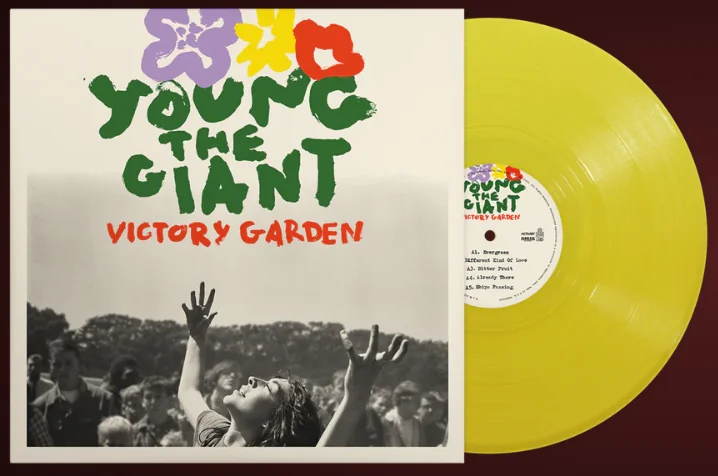
Young the Giant Reclaim the Power of Real Collaboration on Victory Garden on the NRN Radio Show

 DJ Don Edwards
There is a noticeable difference between albums that are constructed and albums that are lived in. One sounds assembled piece by piece until every edge is polished into submission. The other sounds like musicians occupying the same space, reacting to each other in real time, pushing songs forward through instinct, tension, and chemistry. Young the Giant’s Victory Garden belongs firmly in the second category.
Fifteen years into a career that has quietly become one of the most consistent runs in modern alternative rock, the Southern California band has arrived at a record that strips away unnecessary complication and reconnects directly with the strengths that made them matter in the first place. Victory Garden is not interested in reinvention for the sake of headlines. It is interested in connection. The result is one of the most cohesive and emotionally grounded releases of Young the Giant’s career.
From its earliest moments, the album carries the energy of a band rediscovering the importance of collective momentum. Built through full-unit collaboration and shaped during creative retreats in Idyllwild and Joshua Tree, Victory Garden leans heavily into the chemistry between players rather than isolated studio perfection. Songs were developed together, performed together, and refined through interaction instead of fragmentation. That distinction matters because it fundamentally changes how the music moves.
There is a looseness throughout the record that feels intentional rather than unfinished. Guitars breathe. Rhythms expand naturally. Melodies rise without sounding forced. Instead of chasing maximal production or trend-driven experimentation, Young the Giant sound focused on clarity, feel, and emotional immediacy. Working alongside producer Brendan O’Brien only strengthens that approach. The production remains polished enough to carry the scale expected from a major alternative rock release, but it never loses the pulse of musicians feeding off each other in the room.
That balance between refinement and spontaneity has always separated Young the Giant from many of the bands that emerged during the same era. Since breaking through with “My Body” and the now-generation-defining “Cough Syrup,” the group has consistently resisted becoming trapped by formulas or industry expectations. Their catalog evolved carefully rather than dramatically, with each release expanding the band’s identity without abandoning its foundation.
Albums like Mind Over Matter pushed the emotional and cinematic side of the band further into focus. Home of the Strange explored questions surrounding culture, identity, and belonging in America. Mirror Master carried a sharper rhythmic edge and broader sonic confidence. Then came American Bollywood, the ambitious multi-act project that allowed the band to explore family history, personal identity, immigration, and emotional inheritance on a scale few mainstream alternative acts would even attempt.
What has kept Young the Giant relevant through all those transitions is restraint. The band understands that evolution does not always require demolition. Instead of abandoning their core identity every few years, they have refined it, expanded it, and deepened it. More than 2.5 billion streams into their career, they now sound like a band fully aware of who they are and entirely comfortable trusting that knowledge.
That confidence defines Victory Garden. There is no desperation here. No attempt to chase current algorithms. No unnecessary genre pivot designed to manufacture cultural urgency. Instead, the album feels rooted in the understanding that authenticity becomes more valuable over time, especially in a musical landscape increasingly dominated by disposable trends and overproduced sameness.
Lyrically, Sameer Gadhia delivers some of the strongest writing of his career, centering the album around empathy, perspective, and emotional openness without drifting into cliché. His voice has always carried a distinct emotional intelligence that elevated Young the Giant beyond standard alternative rock formulas. On Victory Garden, that quality becomes central to the album’s identity.
The songs do not rely on slogans or oversized declarations. They operate through observation, vulnerability, and emotional specificity. Gadhia approaches themes of connection and shared humanity with maturity rather than performance, allowing the record’s emotional core to emerge naturally. In an era where many artists confuse volume for depth, Young the Giant continue to understand the power of subtlety.
That emotional grounding is what gives Victory Garden its staying power. The album feels deeply human because it is rooted in interaction rather than isolation. You can hear the collective nature of its creation in the arrangements themselves. Every instrument sounds connected to the larger movement of the songs rather than competing for attention inside them.
For JamFest listeners and fans of live-driven musicianship, Victory Garden resonates because it values performance above perfection. This is an album built around the same qualities that make great live bands endure: trust, chemistry, rhythm, and communication between players. Even in its quieter moments, the record feels alive. The songs move with the energy of people responding to one another in real time rather than clicking tracks into place.
That live-band mentality becomes increasingly important in the current state of alternative rock. Too much contemporary music feels optimized for short attention spans instead of long-term connection. Young the Giant move in the opposite direction. Victory Garden invites listeners to stay with it, to sit inside its textures and emotional shifts rather than consume it passively.
The environments where the album was written also matter. Retreating into places like Idyllwild and Joshua Tree gave the band room to step outside the constant pressure cycle surrounding modern music creation. You can hear that breathing room throughout the record. The songs feel unhurried. There is patience in the arrangements and confidence in the pacing. Young the Giant are no longer writing from a place of needing immediate validation. They are writing from experience.
That maturity extends to the band’s broader place within alternative rock itself. Many groups that emerged during the early 2010s either burned out, fragmented stylistically, or disappeared beneath changing trends. Young the Giant endured because they never treated identity as disposable. Even when experimenting sonically, they maintained the emotional sincerity and melodic intelligence that defined their earliest work.
Victory Garden may ultimately become one of the clearest representations of what the band actually is at its core: five musicians who understand how to create emotionally resonant alternative rock without overcomplicating the process. That sounds simple, but very few bands sustain that balance for this long.
The album also reinforces how valuable real collaboration remains in an increasingly isolated recording culture. Modern technology allows artists to create entire albums remotely, often without sharing physical space. While that process can produce impressive technical results, it frequently sacrifices the unpredictable chemistry that occurs when musicians react to each other organically. Young the Giant made the conscious decision to reclaim that interaction, and Victory Garden benefits enormously from it.
There is a warmth throughout the record that comes directly from human presence. The grooves feel connected. The crescendos feel earned. Even the quieter passages carry tension because the performances themselves are dynamic rather than mechanically fixed. That gives the album a replay value rooted in feel rather than novelty.
For listeners following the NRN Radio Show – Unveiling the Enchantment: A Very Special Handpicked New Release by Your Favorite Music Artist, Victory Garden stands as one of the strongest examples this year of a veteran alternative band trusting musicianship, chemistry, and songwriting over spectacle. The show’s spotlight on the album captures exactly why this release resonates so strongly across modern rock circles: it sounds like a band reconnecting with each other rather than chasing the noise surrounding them.
That distinction becomes even more powerful when viewed against the broader trajectory of Young the Giant’s career. Fifteen years removed from their breakthrough moment, the band could easily lean on nostalgia or formula. Instead, Victory Garden feels forward-moving precisely because it does not force itself to be. The album trusts strong songwriting, lived-in performances, and emotional honesty to carry the weight.
In many ways, that may be the album’s greatest achievement. It understands that longevity is not built through constant reinvention. It is built through refinement, trust, and the willingness to keep showing up authentically as both musicians and people.
Victory Garden sounds like a band recognizing that sometimes the strongest creative decision is not to overhaul everything, but to reconnect with the process that made the music feel alive in the first place. Young the Giant have spent fifteen years evolving without losing themselves. On this record, they sound more certain than ever that the chemistry between them remains the most important instrument they have.