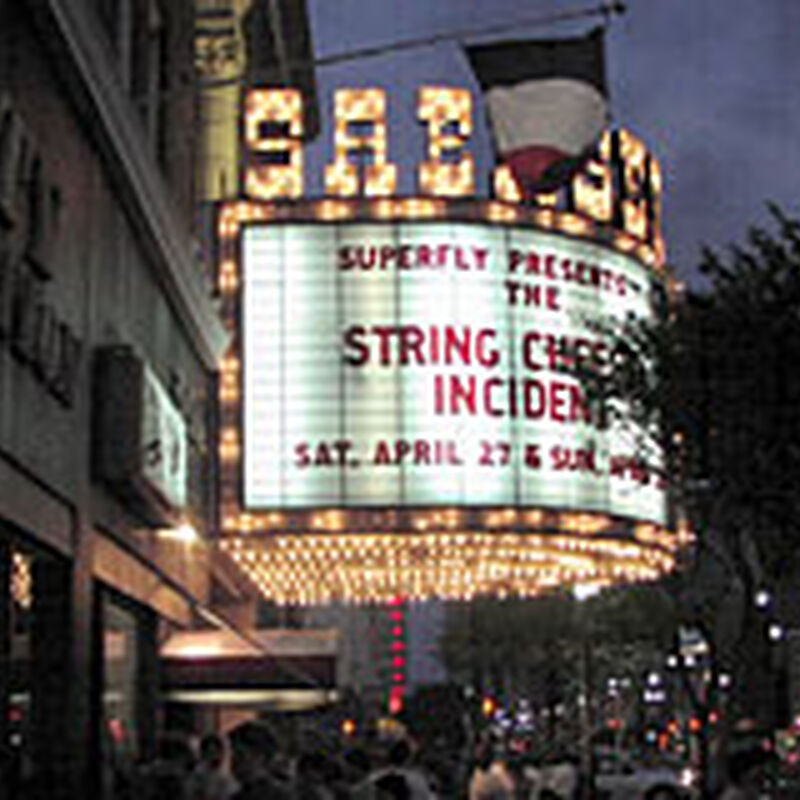
The String Cheese Incident’s May 5, 2000 at the Saenger Theatre in New Orleans is Tonight's Live Nuggets

 DJ Don Edwards
The Night The String Cheese Incident, Béla Fleck, and New Orleans Created One of the Greatest Jam Performances Ever Captured on Tape. There are legendary concerts, and then there are performances that evolve into permanent folklore within the live music underground. They become more than setlists or recordings. They become shared mythology passed from one generation of fans to another through late-night conversations, hard drives filled with traded recordings, faded ticket stubs, old DAT tapes, message board discussions, and obsessive recommendations that begin with the same phrase every time:
“You have to hear this show.”
For fans of improvisational music, jam culture, progressive bluegrass, and the entire live taping community that flourished during the late 1990s and early 2000s, few performances carry that level of reverence quite like The String Cheese Incident’s May 5, 2000 concert at the Saenger Theatre in New Orleans.
More than two decades later, the performance is still discussed with almost unbelievable intensity among dedicated fans. The show has become a landmark document of what made the turn-of-the-century jam scene so magical — fearless improvisation, genre collisions, once-in-a-lifetime guest appearances, deep musical risk-taking, and the unique unpredictability that only emerges when elite musicians collide in the right room on the right night.
And at the center of it all sits one unforgettable performance of “Birdland.”
Now celebrated once again through JamFest and the continuing growth of immersive live music culture, the concert represents exactly the kind of transformational performance that defines the spirit of the Live Nuggets Radio Show, where every Tuesday night at 9PM EST a specially curated handpicked live concert airs in its entirety for serious music fans searching for the emotional depth and spontaneity that only true live recordings can deliver.
Few concerts embody that philosophy more completely than SCI’s historic New Orleans performance.
To understand why this particular show became so important, it is necessary to revisit the atmosphere surrounding New Orleans during Jazz Fest season in 2000. During that era, the New Orleans Jazz & Heritage Festival extended far beyond the daytime festival grounds themselves. Once the official festival sets ended, the entire city transformed into a sprawling overnight laboratory for improvisational music.
The late-night scene became legendary.
Musicians from completely different genres crossed paths constantly inside packed theaters, clubs, ballrooms, and historic venues throughout the city. Sit-ins happened without warning. Collaborative jams stretched into sunrise. Jazz musicians played with bluegrass artists. Funk legends joined rock bands. Avant-garde improvisers collided with reggae performers. Every night carried the possibility of witnessing something entirely unique that would never happen again in the same way.
That atmosphere made New Orleans one of the most creatively dangerous musical environments in America.
And on May 5, 2000, everything aligned perfectly.
At the time, The String Cheese Incident was rapidly becoming one of the defining bands of the emerging jamgrass movement. The group had already established itself as a live powerhouse by combining progressive bluegrass instrumentation with rock improvisation, electronic textures, folk songwriting, Latin rhythms, jazz structures, and dance-driven energy. Unlike many jam bands operating within traditional rock formats, SCI approached live performance with an almost limitless stylistic vocabulary.
The band could move from Appalachian bluegrass into trance rhythms, reggae grooves, jazz-fusion experimentation, and psychedelic improvisation within the span of a single set.
That refusal to obey genre boundaries became central to their identity.
Yet even by String Cheese standards, the May 5 New Orleans show reached another level entirely because of who happened to be sharing the bill.
Béla Fleck and The Flecktones opened the evening.
That alone would have been enough to make the night special. By 2000, Béla Fleck had already completely transformed perceptions surrounding the banjo itself. Rather than treating the instrument as something confined strictly to bluegrass traditions, Fleck expanded its possibilities into jazz, fusion, classical music, funk, world music, and avant-garde improvisation. Alongside The Flecktones, he developed one of the most technically astonishing ensembles anywhere in modern music.
What happened next elevated the evening into jam-band immortality.
During the first set, Béla Fleck and members of The Flecktones joined The String Cheese Incident for a collaborative performance of Weather Report’s jazz-fusion masterpiece “Birdland.”
From the very first moments, the energy inside the Saenger Theatre reportedly shifted into something extraordinary.
The iconic bassline immediately established the recognizable foundation of the Weather Report classic, but what unfolded afterward became something entirely its own. Michael Kang’s mandolin work exploded with improvisational creativity. Bill Nershi’s acoustic guitar lines danced through complex rhythmic changes. Béla Fleck attacked the banjo with impossible precision and fluidity. The Flecktones injected hyper-technical jazz textures into SCI’s adventurous acoustic-electric framework.
The result sounded less like a traditional cover and more like a controlled musical detonation.
Fans who witnessed the performance in person still describe it as one of the greatest collaborative jam moments they ever experienced.
What made the performance especially powerful was the natural chemistry between the musicians. Nothing felt forced. The styles blended organically despite the technical complexity unfolding across the stage. Jazz fusion collided with progressive bluegrass, improvisational rock, and exploratory acoustic music simultaneously. The musicians pushed one another higher and higher in real time, each solo escalating the tension and excitement throughout the theater.
Even today, longtime jam fans regularly point to the “Birdland” performance as a masterclass in ensemble improvisation.
And because of the fiercely dedicated live taping culture surrounding jam bands during that era, the performance survived far beyond the walls of the Saenger Theatre itself.
The soundboard and matrix recordings from the show quickly became prized pieces of tape-trading history. Throughout the early digital trading era, performances circulated heavily through online communities like Shnflac, Etree, and archive-based trading groups where collectors obsessively cataloged concerts down to individual discs and tracks.
That culture created an entire underground archival movement dedicated to preserving live music history.
For older fans, seeing file names like “sci2000-05-05d1t04” immediately triggers memories of downloading shortened audio files overnight on dial-up internet connections, burning CDs by hand, organizing hard drives filled with live recordings, and hunting for cleaner matrix mixes through fan communities scattered across message boards and trading networks.
The shorthand itself became part of jam-band language.
In this case, “d1t04” referred specifically to Disc 1, Track 4 — the legendary “Birdland” performance itself.
For many fans, simply seeing those file labels instantly evokes an entire era of music culture built around discovery, community, trading, and obsessive live-performance appreciation long before streaming platforms standardized everything into algorithms and playlists.
The concert itself, however, was far deeper than one famous collaboration.
The complete May 5, 2000 setlist reads like a perfect snapshot of The String Cheese Incident at one of its most adventurous creative peaks.
Opening with Tim O’Brien’s “Land’s End” flowing directly into “Search,” the first set established an exploratory mood immediately. “Cottonmouth” injected high-energy momentum before the arrival of “Birdland” permanently altered the trajectory of the evening.
From there, the band transitioned beautifully into Peter Rowan’s “Sweet Melinda,” followed by extended improvisational passages and a soaring version of “Shine” that carried the emotional energy forward.
Yet the second set arguably pushed the night even further into legendary territory.
“Rivertrance” exploded with rhythmic intensity before melting into “Rollover,” one of SCI’s defining live improvisational vehicles. Then another major guest appearance arrived when saxophonist Karl Denson joined the band for “Lost.”
Denson’s presence injected a completely different dimension into the performance.
Already respected as one of the premier saxophone players in the jam and funk worlds, Denson brought explosive jazz-funk textures that expanded the improvisational possibilities even further. The performance became looser, funkier, and increasingly unpredictable as the musicians fed off each other’s energy.
“Drifting Away,” “Restless Wind,” and “Outside Inside” continued the evening’s adventurous spirit before the triumphant “Rollover” reprise closed the set with emotional force.
Then came the encore.
SCI returned with a gorgeous version of Bob Marley’s “Bend Down Low” before transitioning seamlessly into “Texas,” sending the New Orleans audience home after one of the most celebrated nights in the band’s history.
What makes this performance so enduring more than twenty-five years later is not merely the technical brilliance involved.
It is the atmosphere preserved within the recording itself.
You can hear the room reacting in real time. You can hear the surprise. The excitement. The escalating energy as the musicians recognize something special is happening collectively onstage. The recording captures the spirit of discovery that defined the jam-band scene during that era — the idea that any random concert on any random night might suddenly become transcendent.
That unpredictability is what made live music culture during the late 1990s and early 2000s feel so alive.
Jam bands were not simply performing songs.
They were building temporary worlds inside theaters every night.
No two shows matched. No performances repeated exactly. Fans followed tours not to hear the same songs, but to witness how those songs transformed nightly through improvisation, collaboration, and audience interaction.
The May 5, 2000 String Cheese Incident concert stands as one of the purest examples of that philosophy ever captured on tape.
And now, through JamFest and the Live Nuggets Radio Show, performances like this continue reaching new audiences searching for something deeper than disposable streaming culture.
These recordings remind listeners that live music is not supposed to feel sterile or predictable.
It is supposed to feel dangerous.
It is supposed to surprise you.
It is supposed to create moments that musicians themselves could never fully recreate again.
That is exactly what happened inside the Saenger Theatre that night in New Orleans.
And that is precisely why fans are still talking about it all these years later.